
Simon de Vries: Forgotten, but Widely Read in His Own Time
Within the Dutch literature of the second half of the 17th century, Simon de Vries (1628–1709) occupies a remarkable place. Having received only an elementary education, he became a successful printer and bookseller; publishing at least 57 works on a wide range of subjects: history, geography, travelogues, poetry, romances, anecdotes. De Vries’s work was widespread and in his own time he was commercially successful. Nevertheless, literary critics of later generations regarded him with a certain dédain, due to the derivative nature of his work, much of which consisted of translations and compilations of older works; accordingly, in the 19th and 20th century he was not included in the canon of classical Dutch literature. Only in 1993, Simon de Vries was deemed worthy of a monograph, in which Arianne Baggerman re‑evaluates the work of this forgotten author as a mirror of intellectual discussion topics within the middle–classes of the Dutch Republic.
Against this background, an analysis of De Vries’s imagination of the Arctic regions is of special interest: as his work was widely read and discussed between 1670 and 1709, it can deepen our insight into prevailing images of the North in early modern Dutch society in general.
Looking at his vast oeuvre1 from a bird’s–eye point of view, three works deal mainly with the High North:
-
Nauwkeurige Beschrijvingh van Groenland (1678), a translation of Isaac la Peyerère’s Relation du Groenland (1647);
-
Reis door Noorweegen, Lapland, Boranday, Siberien, Samojessie, Ys–land, Groenland en Nova–Zembla, a translation of Pierre Martin de La Martinière: Voyages des pais septentrionaux (1653), published in 1685 under de title De Noordsche Wereld together with
-
Reis Verright nae Spitsbergen, of Groenland, in ’t Jaer 1671 under the title De Noordsche Wereld, a translation of Friderich Martens Spitzbergische oder Groenlandische Reise–Beschreibung, gethan im Jahre 1671 (1675).
With these three titles, published over seven years, De Vries provided Dutch readers with a panoramic image of the Arctic, covering the entire known Arctic region. He was the first to do so, and this makes him a relevant and influential intermediary in shaping the popular image of the North within the Dutch Republic of the late 17th century. In all three cases, De Vries made use of already published monographies, which he translated into the Dutch language from German editions. However, he did not content himself with a simple rendering of his sources into his mother tongue. It is a characteristic of De Vries that he added separate elucidations, which were explicitly designated as additions. This appears to be a general translation strategy of De Vries.2 For deciphering De Vries’s intentions in publishing his work, these additions deliver an important key, because as visible deviations from his sources, they reveal more about De Vries’s world–view than about the places described or the view of the original authors. I will therefore analyse De Vries’s projection of the northern world by taking a look at the way he expands his sources by supplying additional information.
Nauwkeurige Beschrijvingh van Groenland (1678)
With the Nauwkeurige Beschrijvingh van Groenland, Simon de Vries published a Dutch translation of the Relation du Groenland by Isaac de la Peyrère, the first French work devoted to Greenland. The Relation du Groenland was not a regular travelogue, but may be characterized as
une compilation d’informations tirées de sagas et chroniques islandaises, danoises et norvégiennes, ainsi que de récits d’expéditions de même origine qu’avait traduits et commentés pour l’àuteur […] un certain “Monsier de Rets” (Peder Reedtz).3
In this case the compilatory character which is typical of De Vries’s works, was already present in the source he used. However, this did not withhold him from making further additions, as we will see.
In the ‘Foreword’ De Vries—in his usual loquacious style— mentions the reason for undertaking the translation:
Terwijl ick besigh ben met verscheydene groote wercken, quam tot my in de voorledene Wintersche avonden seecker Vriend met de Beschrijvingh van Oud en Nieuw–Groenland, in de Hooghduytsche Tael in druck vervaerdighd volgens ’t Fransche Voorschrift, my versoeckende, dat ick dit Uytlandsch Maecksel een Neerlandsch Kleed wou aentrecken. Vermits nu de Koude der gedaghte Wintersche Avonden my somtijds van mijne Boeck–kamer beneden nae dan Haerd drongh, alwaer ick, tot de voortsettingh der genoemde groote Wercken, geen grooten daer toe vereyschten Omslagh van Boecken ontrent my kon hebben, soo heb ick sijne begeerte niet willen afslaen, maer de tijd, welcke ick moest doorbrengen om my wat te warmen, oock besteed in deese Vertaelingh van ’t Beright eens kouden Gewests.4
De Vries states that he took up the project at the request of a friend. We may take this statement cum grano salis, as a rhetorical device.5 In the same ‘Foreword’, De Vries assures that the printer/editor wanted him to make additions to his source text:
Onsen Drucker deese Groenlandsche Beschrijvingh gesien hebbenden, was niet onbillijck van gevoelen, dat deselve aen u, waerde Vrienden, door sijne Druck–perssen behoorde gemeen maeckt te zijn; doch versoght my, om ’t kleyne Werckje wat grooter te doen worden, hier en gintsch eenige Historische Byvoeghselen te willen inlassen; oock daer aghter aen te stellen ’t Kort begriip der eerste Schipvaerden van de Hollanders nae Nova Zembla, om de Doortoght nae Indien te vinden, nevens d’andere dingen, welcke den Korten Inhoud der Hoofdstucken, achter deese Voor–reden gesteld, u sal aenwijsen.’k Heb hem hier in geerne te wil geweest, en alsoo stracks uyt de Pen geworpen een kleyn gedeelte van ’t geen mijne geheugenis in grooter meenighte had konnen voortbrengen; en alsoo koomd u nu ter hand dit t’saem–gevoeghd Werckje.6
In total, De Vries incorporates no less than 23 additions, most of them explicitly listed in the table of contents and headed with the title Byvoeghsel. Here is a numbered list of the themes of the added texts, taken from the Table of Contents and translated into English7:
- Addition about the first inhabitants of the Nordic countries. Position of Norway. Character of the inhabitants. Sámi people, almost without diseases, as well as several other things.
- Addition. Carelessness of the Old Dutch authors in describing their affairs.
- Addition about the first King of Denmark. How Denmark received its name. When it was converted to Christian faith. Error pointed out by several authors.
- Description of Iceland etc.
- Addition about several miraculous sources, bodies of water and streams in many regions of the world.
- Addition on a certain misconception of the author.
- Another addition, dealing somewhat extensively with the true unicorn, and how there are many animals which carry only one horn on their head, with an appendix on swordfish.
- Addition about a one–horned fish, seen in the year 1648.
- Addition about several burning mountains in some regions of the world.
- Addition about several peculiarities of mermen and mermaids. Miraculous whirlpool in Norway.
- Addition about Queen Margrethe, called the German Semiramis (masculine queen) and Danish amazone.
- About Eric IX.
- About Christopher III. Christian I.
- About John. Christiernus II.
- About Frederick the Peacemaker.
- About Christian III.
- About Frederick II. Christian IV. Frederick III. Christian V. War between Denmark and Sweden under 12 successive kings, ongoing for 280 years.
Thematically speaking, the additions are of a mixed character. Most of the elucidations are of a geographical (1, 4) or a historical nature (2, 6, 11–17). More spectacular is a group of five additions devoted to astonishing natural phenomena, such as miraculous headwaters and streams (5), unicorns and swordfish (7, 8), burning mountains (9) as well as mermaids and mermen (10). In this group the adjective wonderlijck (miraculous) appears to be a key word.
Moreover, in a supplement, De Vries provides a series of short treatises on the following themes:
- Summary of the first Hollandic and Zeelandic voyages to Novaya Zemlya, sailing north of Norway, Muscovy and Tartary, in order to find the passage to Cathay and China.
- Short description of the dealings of seven persons who wintered on Spitsbergen in Mauritius–Bay in the year of the Lord 1633 and 1634.
- Short description of the faith of seven sea–men who voluntarily remained back on the Isle of Mauritius in Greenland [Jan Mayen] in order to winter, in the year of the Lord 1633 and 1634, but who died together, taken from their diary, found in their tents at the return of the ships.
- Short description of seven other men who voluntarily stayed on Spitsbergen in the year 1633–1634 in order to winter, but who died as well.
- Miraculous saving of a certain person near Spitsbergen, with a great number of others who died miserably.
- Several other examples of miraculous divine savings.
The first supplement (18) deals with the famous Arctic expeditions of the Dutch in order to find a passage to India, ending with the forced wintering of Willem Barentsz and his fellow seamen on Nova Zembla in 1596–1597. The nos. 19–22 are devoted to fortunate and unfortunate winterings in Spitsbergen and Jan Mayen, organised by the Dutch Northern Whaling Company, as well as to several other wonderlijcke events (23–24). Here, as with the additions, De Vries’s intention seems to be to stress the wondrous and extreme nature of the Arctic regions in general.8 As shown in Table 1, the total number of words in the added texts is 34,162, which is more than 60 % of the whole work (55,955 words).9
Table 1: De Vries's translations and additions: number of words and percentages
| total number of words |
number of additions |
number of words additions |
percentage of text |
|
| Peyrere | 55,955 | 23 | 34,162 | 61 % |
| de la Martinière | 53,185 | 19 | 15,862 | 30 % |
| Martens | 53,478 | 18 | 14,038 | 26 % |
De Noordsche Weereld (1685)
With De Noordsche Weereld, De Vries published two northern travelogues in one. This happened in a decade in which the Dutch Republic developed a great interest in all things arctic. De Vries mentions in the ‘Foreword’ that “many people travel to this region every year”10 This was true, because between 1681 and 1685, no less than 1071 Dutch whaling ships set sail to the hunting grounds in the Northern Ice Sea.11
In the foreword, De Vries stresses his intention to amuse and distract the reader:
Indien gy in de Wintersche Avonden dit Werck geliefd te leesen by een warmen Haerd, soo sult gy, met eenigh vergenoegen, by een goedt Vyer ’t killigh–koude Noorden doorwandelen; ter Zee en te Land. Indien in de Somersche heete daegen, ’t sal U konnen dienen, om de vadsige loomheyd wat te verdrijven. ’t Sy op wat voor een tijd gy deese blaederen gelieft te doorsien, gy sult eenige stof vinden, welcke u sal konnen behaegen; en somtijds al yets, ’t geen u noch noyt, of immers soo niet, is voorgekoomen.12
The two travel accounts that De Vries brought together in the Noordsche Wereld were of a very different nature.13 On the one hand Pierre Martin de la Martinière’s Voyage des pays septentrionaux, dans lequel on voit les moeurs, manière de vivre et superstitions des Norvégiens, Lapons, Kiloppes, Borabdiens, Sybériens, Samojedes, Zembliens, Islandais. The French surgeon Martinière had travelled through several Nordic countries aboard a Danish merchant vessel, recording everything he encountered during his journey. Although being a sceptical observer, he presented the North as the realm of a wild nature and mysterious people, mentioning supernatural elements such as sea monsters and other strange creatures, thereby prolonging the tradition of the wondrous north as known from authors such as Olaus Magnus. On the other hand the description of Spitsbergen by Frederick Martens, who was ship surgeon, too, and who sailed to Spitsbergen aboard a Hamburg whaling vessel in 1671, was not a travelogue in its own right, but rather an extensive systematic description of the landscape, weather, ice, waters, animals, plants, herbs of Spitsbergen, strictly based on his own scientific observations. As we will see, these two heterogeneous works were treated by De Vries in a very similar way.
For his translation of Pierre Martin de la Martinière’s Voyage des pays septentrionaux, De Vries did not make use of the French original directly, but of two German translations, one anonymously published in 1674, the other by Johan Langh published in 1675.
As with De la Peyrère, De Vries inserts several additions of his own, 19 in all. These Toe–doeninghen, as he calls and heads them, account for 30 % of the whole text. Here is a numbered list of the themes:
- Partition of Jutland.
- Former and present partition of the North.
- Further description of moose.
- Remark on the preceding story of selling wind by Sámi magicians.
- Further reports on the Sámi.
- Further description of reindeer.
- Further notice of remarkable things in Sápmi.
- Short report of the animals called sables.
- Short report of the region Siberia.
- The greatest honour and sign of friendship of the Muscovites to their guests.
- Anica, a rich farner in Muscovia.
- Walruses, what kind of sea animal they are.
- Short remark on the description of these birds.
- Broader report of the kayak, or small watercraft of the indigenous people of Novaya Zemlya and Greenland.
- Short description of the manner of capturing whales by the Sámi.
- About Iceland
- Notice, in which we give a broader report of Mount Hecla and the ice previously mentioned.
- [Unicorn] Remark on the negation of its existence by our author.
- Remark on the preceding report of the Sámi.
Again, De Vries’s additions are of a varied nature. As with Isaac de la Peyrère, there is a group of insertions that obviously deal with geography (1, 2, 3, 9, 16). Others have to do with morals and customs of the Northern people (4, 5, 7, 10, 11, 14, 15, 18). Arctic fauna is also a topic (6, 8, 11, 13, 15, 19) as well as other more or less spectacular aspects of nature (17).
By taking a closer look at two items, we are able to obtain a more precise image of De Vries’s intentions in translating and extending his source. These are trading in wind by the Sámi people (addition no. 4) and the question of whether unicorns exist (addition no. 18).
As for the wind trade, De la Martinière recounts how somewhere near the Arctic circle in Norway he bought 3 knots of wind in a linen sachet from a local magician. In untying each knot, the wind changes in force and direction. In his addition De Vries assures the reader that although there are lots of people who doubt the veracity of the myth of wind–trading Northern people, there is every reason to assume the authenticity of the story as we have a reliable eye witness:
Ondertusschen, wijl wy hier weer een varssche Getuyge hebben, die ons daer van beright en verseeckerd, niet uyt hooren seggen, maer uyt eygener Ondervindingh, als die alles gehoord, gesien, en gevoeld heeft, soo konnen wy niet laeten, een volkoomen Historisch geloof aen deese saeck te geven.14
As for the unicorn, De la Martinière is rather sceptical about the existence of this fabled animal. Arriving in Copenhagen, at the end of his travels, he presents the Danish king with narwhal–teeth, explaining that these are not the horns of the mythical animal the king expected them to be. De la Martinière continues his narration by noting that there seems to be a great confusion in literature as to what kind of animal the unicorn exactly is, that no one has ever seen one, and that its horn does not possess any special power.
De Vries however, in an addition counting over 1,300 words, makes a great effort to refute De la Martinière’s arguments and to defend the existence of the unicorn and the special power of its horn.15 Thereby he relies on Pliny, Sebastian Münster, Marco Polo and other authorities, the same authorities that De la Martinière rejects. Hereby Simon de Vries revives the old framework of the realm of a wondrous Northern nature with strange and fabulous animals, known from ancient stories.
Frederick Martens’ description of Spitsbergen received a similar treatment. This was a work of a very advanced scientific nature. After returning to Hamburg in 1671, Martens was given intellectual support from two learned friends and mentors, Michael Kirstenius and Martin Fogelius. They convinced Martens of the scientific importance of his work and assisted him in revising and completing his manuscript and systematizing his observations. Moreover, through Henry Oldenburg, secretary of the Royal Society for the Improvement of Natural Knowledge, who had business relations with the Hamburg publisher Gottfried Schulz, Fogelius succeeded in getting Martens’ work published. Oldenburg himself was the author of the Enquiries for Greenland, a list of 20 big research questions on the Arctic region, published in the Philosophical Transactions of 1666, asking whalers and other northern travellers to assist in answering these questions. Fogelius translated this programmatic list into German for Martens. To Martens, Oldenburg’s call for cooperating as a ‘citizen scientist’ within polar research was a great inspiration. So through his local learned connections the humble surgeon Martens had the opportunity to deliver a contribution to the leading international scientific discussion of his time. Thanks to the remarkable quality of his observations, the drawings and the rich style, full of elaborate and poetic comparisons, his work remains a point of reference for polar research up to this day.16
How did De Vries deal with this remarkable work? Again, he adds several elucidations, headed as Toedoeninghen. With over 14,000 words, these additions take up over 20 % of the text as a whole (cf. Table 1). Here is a numbered list of the 18 themes:
- History of Old–Greenland.
- The blubber cutter.
- The discovery of Spitsbergen.
- Observations on the Waygat by Linschooten.
- Observations on ice by Linschooten and Barendsz.
- Places in the world with great amounts of snow.
- Use of scurvy–grass by Linschooten.
- Strange snowbirds in Nordic regions.
- Lombs–bay.
- Strange ways of breeding of seagulls.
- Discussion of origin of the brant goose.
- Encounters with and curious facts on polar bears.
- Crayfish, blackfish, polyps, seaspiders.
- Unicorns
- Fight between orca and another whale.
- More facts about sharks
- Whales
- How the Dutch capture whales
Once again, the additions are of a mixed character. However, in this case there appears a clear dominance of elucidations of the sensational and extreme nature of the Arctic climate (5, 6) and fauna (8, 10, 11, 12, 13, 14, 15, 16, 17). As for the unicorn, De Vries repeats his point that there must exist such an animal. Also, it comes as no surprise that during the peak of Dutch whaling in the 1680s, De Vries devoted some extra attention to the biology, capturing and processing of whales (2, 17, 18).17
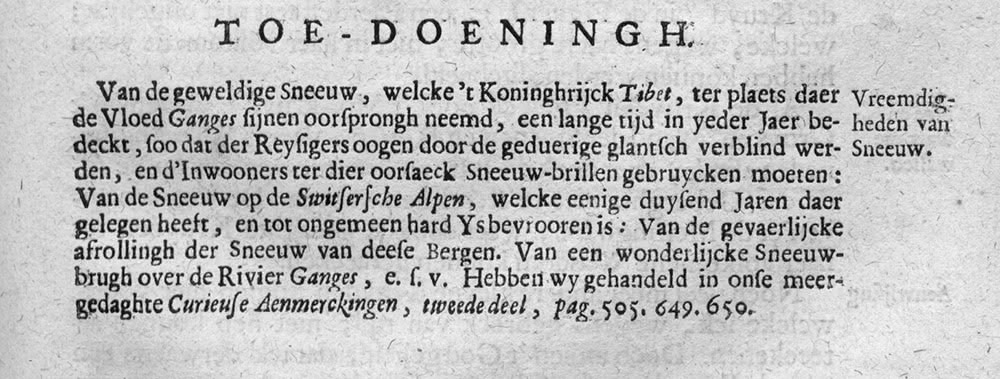
A fine example of De Vries’s way of dealing with Martens’s work, is the short added text which in margine is announced as ‘Vreemdigheden van Sneeuw’ (Curiosities about snow). It deals with places in the world that are known to have enormous amounts of snow (ill. 1):18
Ill. 1: Addition by De Vries on places in the world presenting enormous amounts of snow, with a reference to his own work
With the kind permission of the University of Groningen Library (signature Sb 13the), <https://archive.org/details/gri_33125011115199/page/n231/mode/2up>.
Martens’s goal was to deliver a description strictly based on his own observations. De Vries however does not hesitate to relate all kinds of non–verified histories from dubious written sources. As in the example above, he refers more than once to his own works, which themselves are compilations from other written sources. In this way the empirical scrutiny of Martens’s work is counteracted and replaced by a more traditional approach that emphasises a mythical and wondrous–spectacular image of northern nature. With these additions De Vries obviously tried to make the work appealing to his readers, an audience that was scientifically curious as well as thrill–seeking and who wished to be informed and amused at the same time. These readers could enjoy and believe sensational stories without paying much attention to its empirical foundations in reality.
At the same time the references to his own earlier works are of an advertising nature and may be explained by De Vries’s status as a businessman and commercial author, who was financially dependent on the earnings from the books he sold.19
Conclusion: Early Modern Modes of Imagining the North
Simon de Vries lived in a time of shifting paradigms of imagining the High North. As ever more travellers visited the Arctic regions and made their own observations, the old mythical image of the North as a realm of magic and monsters was gradually replaced by a more scientific–empirical approach. As a commercial writer, De Vries knew about the fascination the North provided for a broad circle of Dutch readers. In translating three recent foreign travelogues within a period of seven years he tried to satisfy their curiosity, thus providing a panoramic image of the Arctic region with an unprecedented encyclopaedic width. However, the elucidations he added to his sources show that De Vries propagated a traditional mythical image of the North, which increasingly was at odds with the observations and intentions of the authors he translated, but that still enjoyed an enduring popularity with the readers he targeted.20


